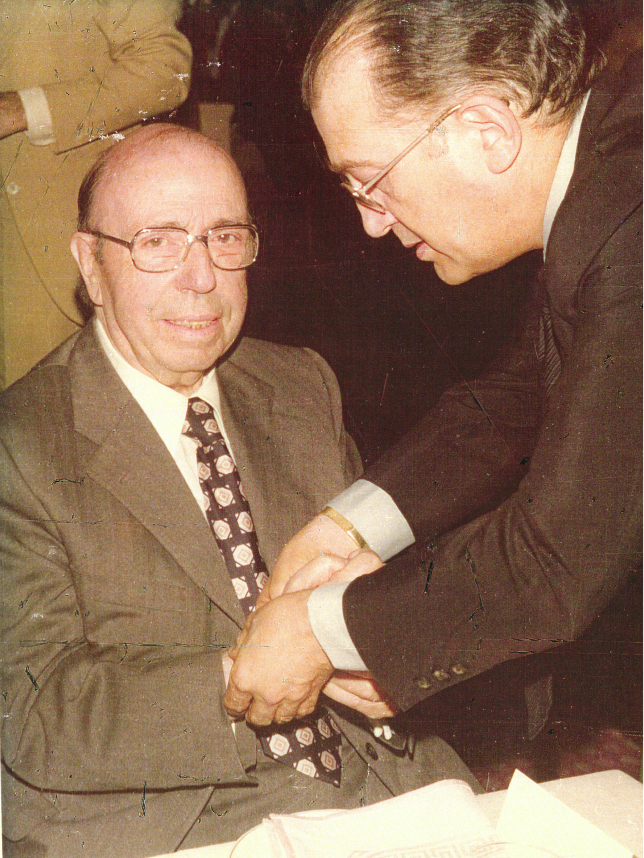
Dr. Antoni Esteve i Subirana
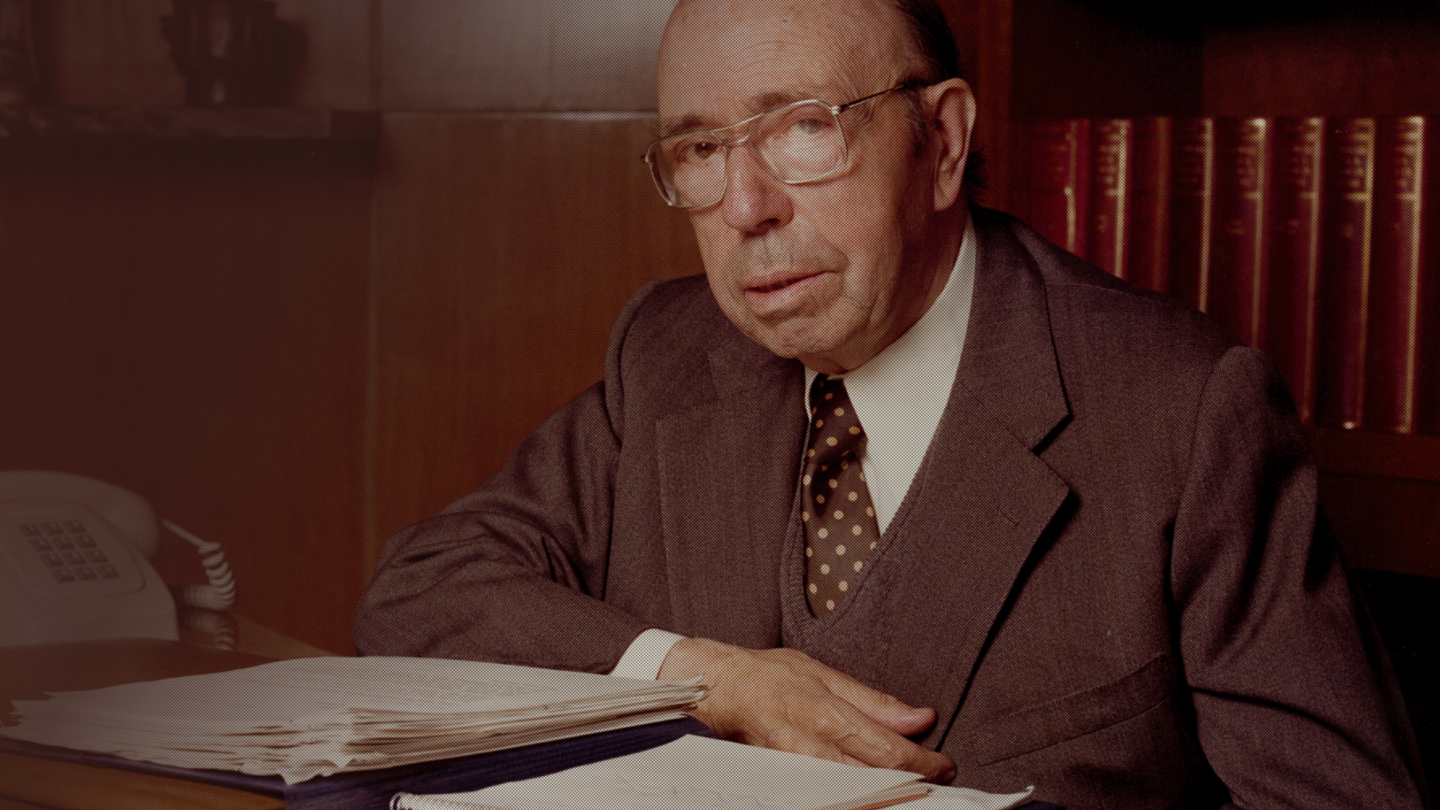
Origins
Born on December 23 in his family’s home on Urgell Street in Manresa, Antoni Esteve i Subirana was the fifth in a line of apothecaries that started in 1787 when Tomàs Esteve i Gavanyach took the reins at the pharmacy in Manresa’s Hospital de Sant Andreu.
Degree in Pharmacy
He graduated from the University of Barcelona, receiving the prize for outstanding achievement. A few years later, in 1932, he obtained his PhD in Pharmacy.
Paquita Soler i Casurellas, a fundamental pillar
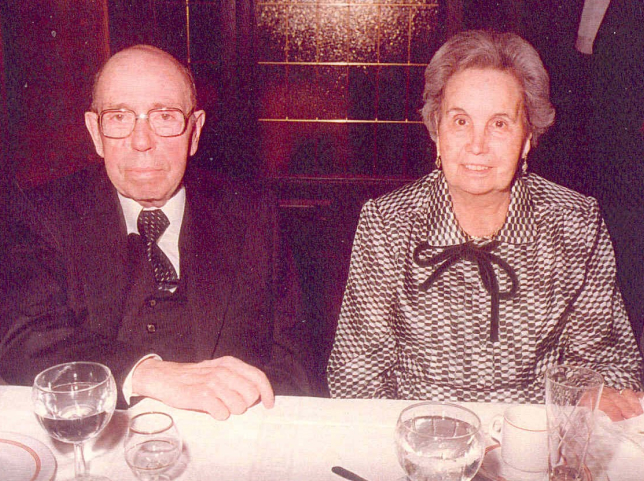
He married Paquita Soler i Casurellas.
Her perseverance and work ethic were essential to the company’s progress and to making the dream of creating a chemical–pharmaceutical laboratory a reality.
Driving entrepreneurship and research
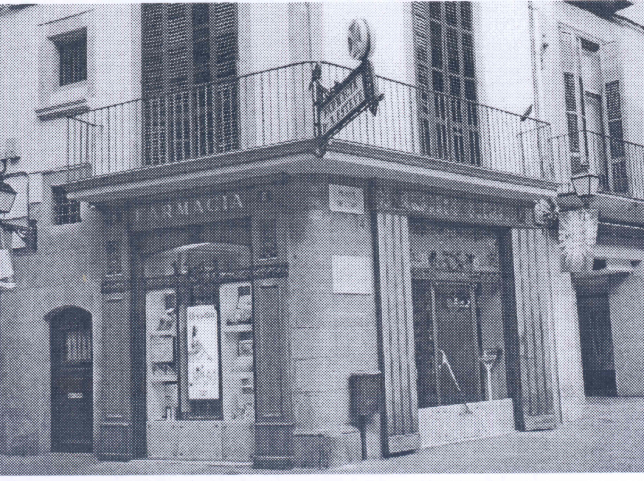
He assumes control of the family pharmacy, located in Manresa’s Plaça de l’Om. His pioneering spirit and strong vocation for research and innovation lead him to set up a small laboratory for clinical analyses in the second floor of the establishment.
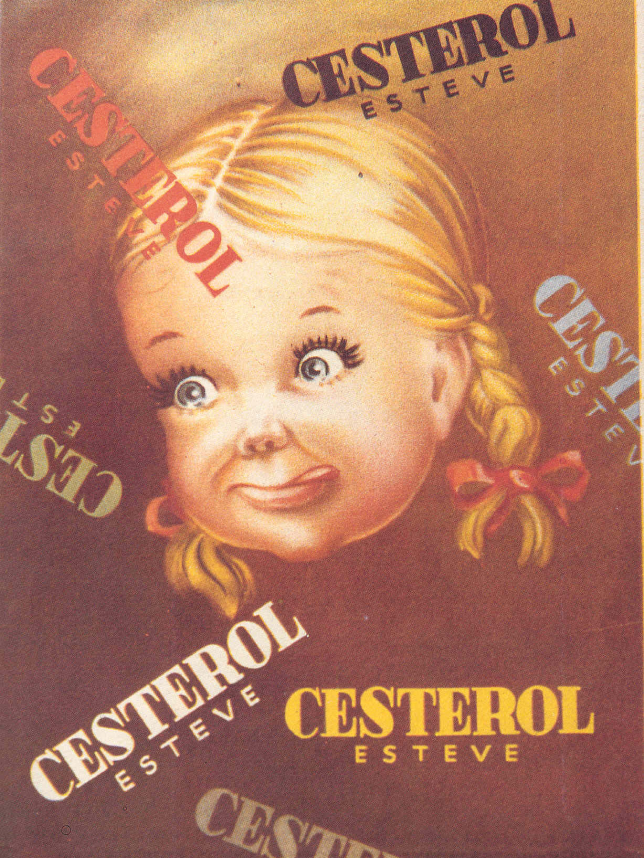
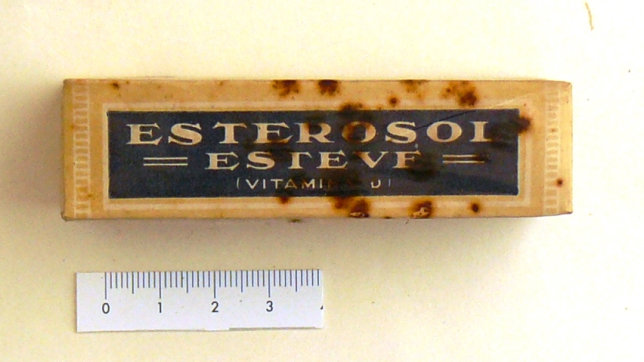
As a result of his research, he obtained vitamin D by irradiation for the first time in Spain: Esterosol. Esterosol combined two vitamins—C and D—which, despite being chemically incompatible, were successfully formulated together in a product that became popular among children and adults.
A new laboratory in Manresa
Dr. Antoni Esteve set up a new laboratory on the upper floor of his house in Urgell Street in Manresa to develop chemical and pharmaceutical products. Together with the laboratory above the pharmacy, these became the two seeds of what would later be known as Dr. Esteve Laboratories.
Launch of Neo-Spirol
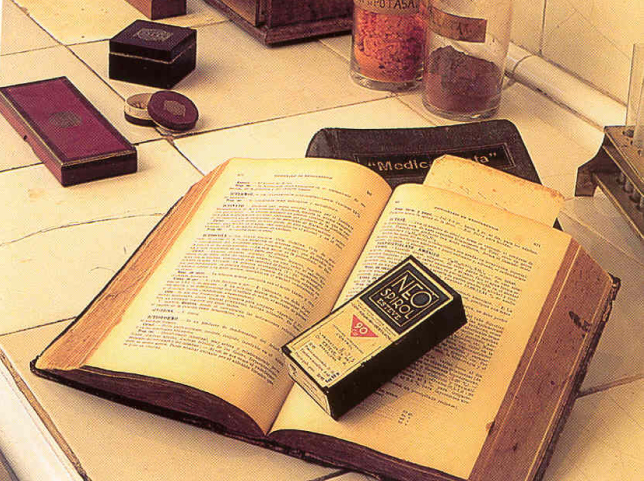
After years of research, the company launched Neo-Spirol—the first antisyphilitic medication marketed in Spain.
Vice presidency of the Academy of Medical Sciences of Catalonia and the Balearic Islands
He became vice president of the Academy of Medical Sciences of Catalonia and the Balearic Islands; a position he would hold again in 1963.
1939
Production of Sulfonamides
During the Spanish Civil War, he began producing sulfonamides for the first time, following the discovery by german chemist Gerhard Domagk. This production became essential in ensuring the supply of medicines during a period marked by severe shortages of raw materials.
According to Oriol Castellet of the Institut d’Estudis Catalans, this accomplishment represents “one of the most important achievements of the Catalan pharmaceutical industry.”
First antibiotics
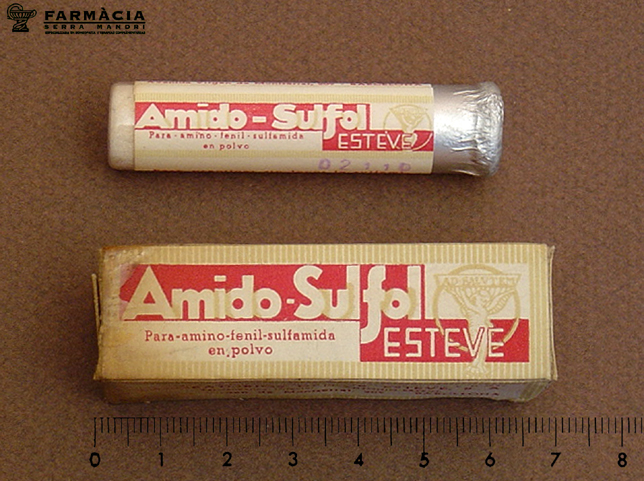
His research enabled him to synthesize and manufacture another essential product: p-amino-phenyl-sulfonamide, registered under the trademark Amido-Sulfol, one of the first antibiotics of the sulfonamide group sold in Spain.
As a result of his research, he synthesized and began producing another essential medication: p-amino-phenyl-sulfonamide, registered under the name Amido-Sulfol. It was one of the first antibiotics in the sulfonamide group to be marketed in Spain.
Exile and french influence
During his exile in France, Dr. Antoni Esteve i Subirana served as head of research at the French company Usines Chimiques des Laboratoires Français (UCLAF). This experience was key for the projection of the laboratory in the 1940s.
Meanwhile, Paquita Soler took on the responsibility of keeping the pharmacy and the laboratory running, with the constant support of Francesc Pagès Gili from Barcelona.
Move to Barcelona
A fire in the laboratory on Urgell Street in Manresa, accelerated the definitive transfer of the company to Barcelona.
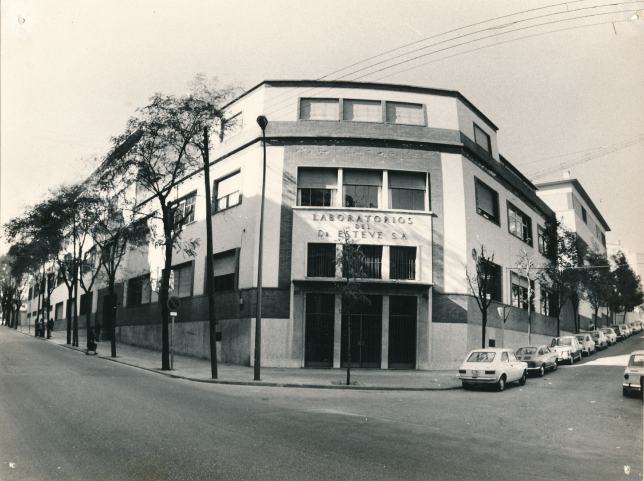
In 1942, Dr. Esteve Laboratories moved their headquarters to Mare de Déu de Montserrat Avenue, in Barcelona’s Horta-Guinardó district.
Alexander Fleming’s visit
Dr. Alexander Fleming, discoverer of penicillin, visited the laboratories, drawn by Dr. Esteve’s exceptional work.
At that time, the laboratories had already carried out tests with penicillin and were distributing informational brochures to guide medical professionals.
Admission to the Science Section of the Institute for Catalan Studies
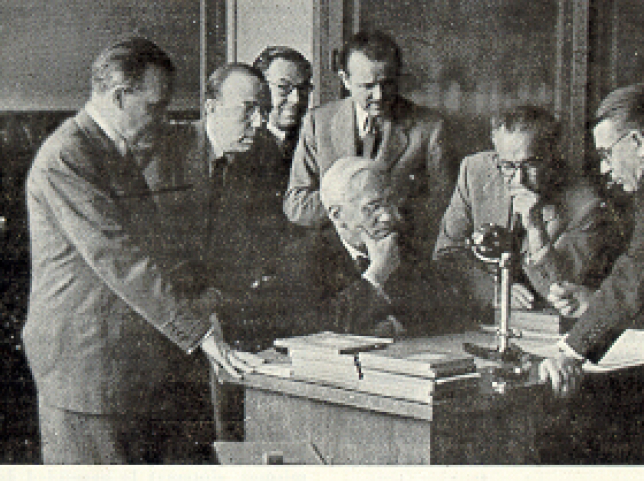
He was admitted to the Science Section of the Institut d’Estudis Catalans (IEC).
That same year, he synthesized and marketed the antihemorrhagic Naphtionin, which opened the door to international exports. He later synthesized other compounds, including the vasodilator calcium dobesilate (Doxium).These medicines paved the way for future business collaborations around the world.
Appointment as full member of the Institute for Catalan Studies
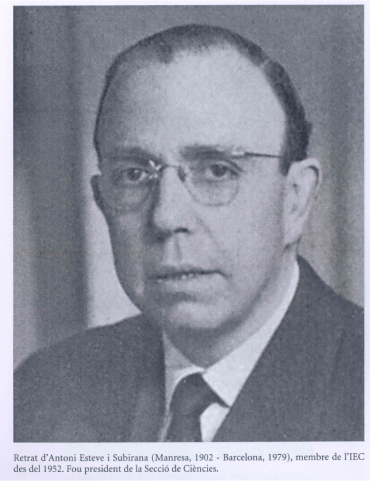
Antoni Esteve was appointed full member of the Institute for Catalan Studies (IEC), and four years later, he became the president of the Catalan Society of Physical, Chemical and Mathematical Sciences.
In 1963, he became a full member of the Catalan Society of Biology.
Renewed leadership at the Royal Academy of Pharmacy
He became the third president of the Royal Academy of Pharmacy of Barcelona (now the Royal Academy of Pharmacy of Catalonia), an institution he had belonged to since 1950.
Goodbye to Antoni Esteve i Subirana
Antoni Esteve i Subirana died on June 13 at the age of 77. He left behind a significant scientific and cultural legacy, driven by his deep passion for pharmacology and his strong commitment to Catalonia.